

Starmer and the Nazgul of Events
Can he fight them all off at once?

Politics is driven by ideas, culture and events. Ideas and culture may sometimes clash to produce unintended consequences. These consequences, and events from outside the system, will dictate the outcome. The economist and philosopher Nassim Nicholas Taleb used the term ‘black swan event’ to describe those events which occur rarely, and which are not only unexpected but unpredictable by virtue of being very rare. These events can have huge impact, and usually produce severe consequences. When ideas clash with culture and are combined with events completely outside the control of those generating the ideas then things become traumatic, damaging and subject to excuses and self-exculpation. A good example of a black swan event is the banking crash of 2008. This event was not foreseen despite the warning signs in the banking system. The result was a collapse of the banking system and a worldwide recession.
But there are other events which can be foreseen (to an extent) and which combine to cause mayhem. Let us call these ‘Nazgul Events’. These are things which can be seen, where they exist as prominent signals within the system, but whose outcomes are uncertain and beyond the control of the actors, be they bankers or politicians.
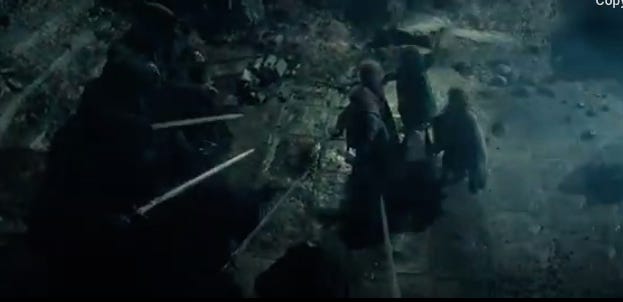
In the first book of Lord of the Rings, The Fellowship of the Ring, the four Hobbits, Frodo, Samwise Gamgee, Merry and Pippin, along with their guide and protector Aragorn, are pursued by the Nazgul whose number grows as the story progresses. The Hobbits know that they are pursued and know that their pursuers are evil and are intent upon seizing the Ring of Power from Frodo. Pursuers and pursued meet at Weathertop and the Nazgul surround the Hobbits. The Nazgul are temporarily defeated by Aragorn in a ferocious fight, but not before Frodo is stabbed by the Nazgul. His survival is in the balance and the outcome is uncertain.
So it is with current politics and our survival as a free and democratic nation state in the UK.
Keir Starmer entered No. 10 Downing Street as the son of a toolmaker, a former human rights lawyer and Director of Public Prosecutions. Whilst Labour were in opposition, Starmer was crowbarred into a safe Labour seat in 2015 and then ultimately elevated to Leader of Her Majesty’s Loyal Opposition. He has been in politics for only nine years, never had to properly fight for his own seat, and he has never had any experience outside the public sector - with its pleasant working conditions of a maximum of 35-hour, four to five day weeks and generous holiday allowances.
Being a Prime Minister in the UK is to enter a full-on 24 hours a day, seven days a week job. For this reason, incumbents live in the flat above the office. One minute might involve being briefed on a very delicate international problem, another might involve the errors of judgement by a colleague and unravelling it for the press; another minute might involve shaking hands with a potentate from an objectionable regime and yet another might mean having to meet Bill Gates and do a photocall. There are international summits and speeches to give. On top of that, there is Prime Minister’s Questions on Wednesday in the House of Commons and for which considerable preparation is needed. Being a Prime Minister is an extremely high pressure job, under the full glare of 24/7 media coverage. This is one reason why the rate of attrition has been so high in recent years.
According to the journalist Adam Raphael in the Observer, Harold Macmillan was once asked what the most troubling problem of his Prime Ministership was. ‘Events, my dear boy, events,’ was his reply. [https://quoteinvestigator.com/2020/08/31/events/] This brings us to the problem of forthcoming events - certainly with Nazgul Events, perhaps even Black Swan Events - and whether Starmer has the ability to fight them off.
Let us first of all list the international events that are happening now, or may happen in the near future. These might be considered as Nazgul events - their existence and their threats are known about, but their timing, extent and outcomes of their actions are unpredictable.
1. The Russia/Ukraine war – this seems to be dragging everyone into it, whether we like it or not. The slaughter which is happening in Eastern Ukraine is bogging down again in the wet black soil of a very mild winter, and which brings heavy tanks and vehicles to a slithering halt. It has become a war of attrition which no-one wants, and which is wasting young Ukrainian and Russian lives in a war over a piece of territory whose ethnic stability was interfered with by Josef Stalin in the 1940s. In 1945, huge numbers of ethnic Ukrainians were transported to Eastern Siberia, and equally huge numbers of ethnic Russians were moved into eastern Ukraine. The Russian need for a Black Sea port and ethnic cleansing set the seeds for the problem we see now. This has been considerably exacerbated by the steady expansion of NATO into countries that were formerly part of the Warsaw Pact, and the engagement of NATO hardware and ‘advisors’. The approach so far has been to try to contain and then remove Russian troops from land within the pre-war Ukrainian borders. But that is looking increasing idealist as the Russians have dug into large chunks of eastern Ukraine and are doing what they do best – which is defence. The United States response has been decided so far by the Biden administration, but is very likely to change once Trump takes office on the 20th January. Starmer will inevitably follow Trump’s lead because he has to. He has no effective power in this issue. Every other NATO country will do the same thing and for the same reasons.
2. A side issue to the Ukraine war is that over Christmas, two power interconnectors have been severed between Finland and Estonia. Both countries are now members of NATO. The vessel responsible is Chinese owned. Finnish police have boarded it and made arrests and apparently some of the crew are Russian. It is also allegedly stuffed with electronic eavesdropping equipment. An attack upon one NATO country is deemed to be an attack upon all. If Russia is involved, then it is quite clearly a provocation. If China is also a proxy in this, then that extends the problem further.
3. China’s ability to wage war is rapidly expanding and is making its presence felt in the Pacific. Japan and Taiwan are feeling the heat, as is the US Pacific fleet. Starmer may well feel that this is out of his remit, and indeed, the Royal Navy is in a poor state and will be ineffective, except possibly in providing empty aircraft carriers as a useful landing place for US aircraft.
4. The Middle East is another problem which can draw in the US and the UK. Syria, Lebanon, Israel, Turkey and Iran are all gearing up for one big fight, or maybe several smaller ones. Iran and Israel are nuclear states and have the capability to obliterate each other. Starmer is well connected with the Jewish legal community in London and will probably feel compelled to make some sort of move. On the other hand, he also has the UK Muslim community to appease. This will provide him with a moral and political dilemma which is likely to give him sleepless nights.
5. Closer to home, Europe is getting more difficult. At the time of writing, opinion polls suggest that Germany is unlikely to elect Alice Weidel of the AfD in the 23rd February Federal Elections as Chancellor. However, a combination of the AfD along with the likely winning alliance of the centre-right CDU/CSU suggests that Germany is about to take a convincing turn to the right. Weidel has clearly indicated that the illegal immigrants should be returned to their native countries and limiting or stopping other immigration. It is possible that the CDU/CSU alliance will adopt something like this as their own policies. If this were to happen then this will bring Germany into diplomatic conflict with the European Union.
6. Meanwhile in France, Marine Le Pen Is busy doing much the same thing as Alice Weidel. The impact of both of these is to diminish the importance of the European Union policies on immigration. In addition Le Pen is euro sceptic and has expressed the desire to remove France from the euro. As well as the Eastern European states, the combination of a stringent immigration policy and exit from the euro will bring about the slow, long-term decline of the European Union as an institution and governmental body. Across Europe as a whole the increasing euro-scepticism and demand for national sovereignty amongst nation states will further diminish the power and reach of the European Union.
7. In addition to activities at governmental level, the peoples of many of the nation states are becoming restive. In Germany, the Netherlands, France, Denmark and Belgium, farmers are protesting about the damage that that Net Zero policies are having upon their businesses and food production. In addition to the farmers, ordinary people, including the middle classes, are also protesting at the damage that policies are having upon their standards of living and culture. All of these factors are combining to reduce the importance of the globalist agendas. Whilst the EU as an institution is constantly attempting to increase its power and reach, it is steadily being diminished from outside the institution by the nation states. The clash between the institutional insanity and common sense will continue to bring difficulties as the EU fights for its ideological survival.
8. In the United states, Donald Trump will have a radical effect at every level of the economy and international influence. It is now quite clear that he will stop funding and withdraw from the World Health Organisation. It is also likely that he will withdraw or otherwise reduce payment to other United Nations bodies such as the IPCC. The effect of Musk upon the administration of U.S. government will be profound in that it will radically reduce the number of bureaucratic organisations affecting the lives of ordinary Americans and the economy as a whole. The most likely outcome of this reorganisation will be to unleash the enormous power of productive America. The Trump administration is looking to dismantle all DEI in both corporate and governmental America. Donald Trump has also made it clear that he intends to look at the way NATO is funded and assisted by its member states. There is even the suggestion that he may withdraw the United States from NATO altogether, and leave Europe to defend itself.
9. In Argentina, Javier Milei has already transformed the previously decrepit Argentinian economy. His ‘chainsaw economics’ has slashed bureaucracy dramatically and this has allowed him to simplify and drastically reduce taxes. He has achieved that within one year. It is now likely that Argentina will become a major economy very quickly, and this will drive most South American countries into adopting similar policies.
10. In Europe and the Americas, many political events are being driven by the resurgence of the nation state and proper democratic governance. This will clash with the current narrative of globalism to create unpredictable results. The old order is now under attack. Starmer represents the old globalist order and is allying himself with a series of potentially dying ideologies and tired and unpopular leaders such as Macron, Trudeau, Scholz, Rutte and von der Leyen. Starmer has come late to the party and is already beginning to resemble an anachronistic sore thumb.
11. In terms of international conflict, Starmer will be obliged to follow Trump, who's approach to international affairs will be very different from that of the Biden administration.
12. In economic, social and cultural terms, Starmer will suffer from comparisons with the United States and Argentina. In Canada, the ‘woke’ toy boy Trudeau will most likely lose to the seriously competent Pierre Poilievre. In which case, the whole of North America and a chunk of South America will have turned emphatically right. The importance of this bloc to our economy will be impossible to ignore, even if the sclerotic left in Europe continue to impede sensible progress.
All that is on the international stage. But let us now consider the factors which may have a serious effect upon domestic affairs.
13. Perhaps the biggest economic problem that Starmer faces is the sheer insanity of Ed Miliband's Net Zero policies. These are breaking what is left of our manufacturing industries, and impoverishing many private individuals by means of very high energy bills. Miliband’s insistence that we should all be driving EVs is effectively making motoring for any reason too expensive for most of us. This is clearly an anti-car and anti travel agenda.
14. Added to these to these are the serial assaults upon the economy by Rachel Reeves, the Chancellor of the Exchequer. The first and most well known assault was made upon old age pensioners and the removal of the winter fuel payments. The second was the imposition of inheritance tax upon farmers. In both of these items of self-inflicted electoral harms, Rachel Reeves has created two sets of people who will withdraw their vote from the Labour Party completely. In the case of the farmers she has awoken a sleeping giant with very large pieces of kit. Even though they are small in numbers, the farmers have the capacity to bring the country to a halt should they decide to do so.
15. Unconstrained immigration is a problem mostly created by successive Conservative governments, but is one which the Labour government will have to deal with. They have made repeated promises to halt the illegal immigration across the English Channel but have failed to stop the flow. Indeed the numbers crossing by this means have reached record levels since the start of Starmer's government. The consequences of unconstrained immigration mean that hotels are stuffed full of illegal immigrants who are predominantly young men of military age and who have nothing to do. Local communities blighted with these hotels are in uproar. Once again this is creating a negative effect upon Labour’s polling percentages and electoral chances.
16. The Southport murders, the subsequent riots and the government's response has created an extraordinary linkage directly from what Starmer said were the causes of the riots, and what he actually knew before the riots happened. Starmer's allegations of ‘far right thugs’, do not stack up with what are now known to be the facts. The government's response of locking up people for minor infractions and social media posts, whilst at the same time releasing dangerous criminals from overcrowded prisons in order to make room for very minor offenders (or even completely innocent people) has excited outrage across society and across the US.
17. An additional twist to the Southport saga is the suspicion, prompted by an alleged government whistleblower, that Starmer had represented the Rudakubana family in their asylum case from Rwanda to the United Kingdom in the early 2000s. In fact there is very little evidence so far discovered to support this allegation. The investigation to discover the truth is thoroughly and objectively considered by Charlie Bentley-Astor. Despite having drawn a blank, the suspicion remains that Starmer, who had had plenty of involvement with other refugees from Rwanda, is somehow connected to the Rudakubana family.
18. The media narrative has rather strangely overflowed from the Southport murders and its fallout, into the issues of the Pakistani Muslim rape gangs. It has also captured a part of the immigration issue along the way. The extraordinary explosion of media interest and commentary upon the rape gang issue over the last week (which has actually rumbled on for some years, but without attracting the outrage that it now has) was largely prompted by the release of the Judge’s summing up and sentencing in a recent case. Many of the details of the abuse that the underage girls received from the men involved goes beyond rape and into the bounds of torture. The vast scale of this repugnant story in the UK over the last 20 or 30 years, and the abject failure of the authorities to deal with it, attracted the attention of Elon Musk over Christmas, and he has commented widely and angrily upon it. This has further brought other US commentators, such as Alex Jones to express complete amazement at what is happening in the UK. Inevitably, the UK’s standing has been severely diminished in the eyes of the incoming administration of the United States. Whilst the Tories can be legitimately blamed for not having done anything about the rape gangs, the involvement of the Labour councils and the police in ignoring and facilitating the problem is intimate. This issue will come back and bite Labour many, many times.
Annunziata Rees-Mogg has said this:
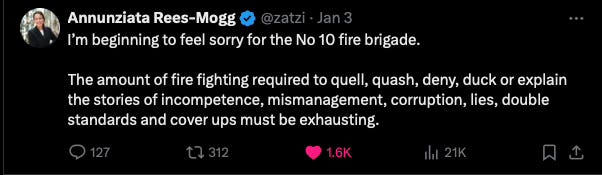
There are many, many other scandals which will come out. This Labour government is like an old roof tile that has been resting in a corner of your garden. Turn it over and hundreds of woodlice and other creatures will scurry about, looking for somewhere to hide.
The main point of the long list above (but which is actually very much shorter than it should be) is to give the merest taste, a flavour, of the things coming down the line to hit a Prime Minister who has spent well over a month out of the country, when he has only been in office for six months. The items in the list are not the relatively trivial things of a more peaceful time in politics. These are major events - many of which, each on its own, have sufficient destructive power to bring down a government. The likely possibility of several of them hitting this government all at once will be overwhelming.
Starmer has just returned from what he feels to be a well-deserved holiday. The degree of his awareness as to what is going on in the political world which he inhabits (but does not seem to understand) is encapsulated in this, from the 3rd January - a real finger-on-the-pulse-of-the-nation tweet - just as savage criticism from the United States, as well as his own country, was approaching a zenith:
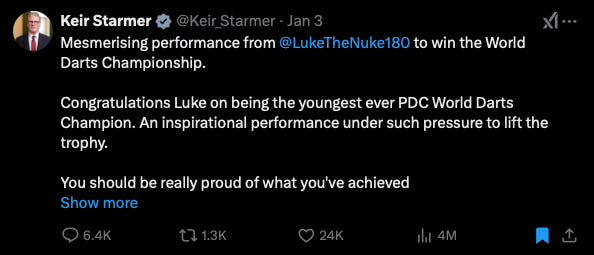
Starmer clearly feels that this post is sufficient to distract the country away from the real issues, and especially the historic involvement of the Labour Party in perpetuating and entrenching the rape gangs. On his return to No. 10, doubtless fresh and re-invigorated, he has responded to Musk’s blunt interventions on X. In another tweet (below) he is “gearing up” to “reset” his progress in government so far.
Presumably, the “resetting” will involve switching the Labour government off, and then back on again.
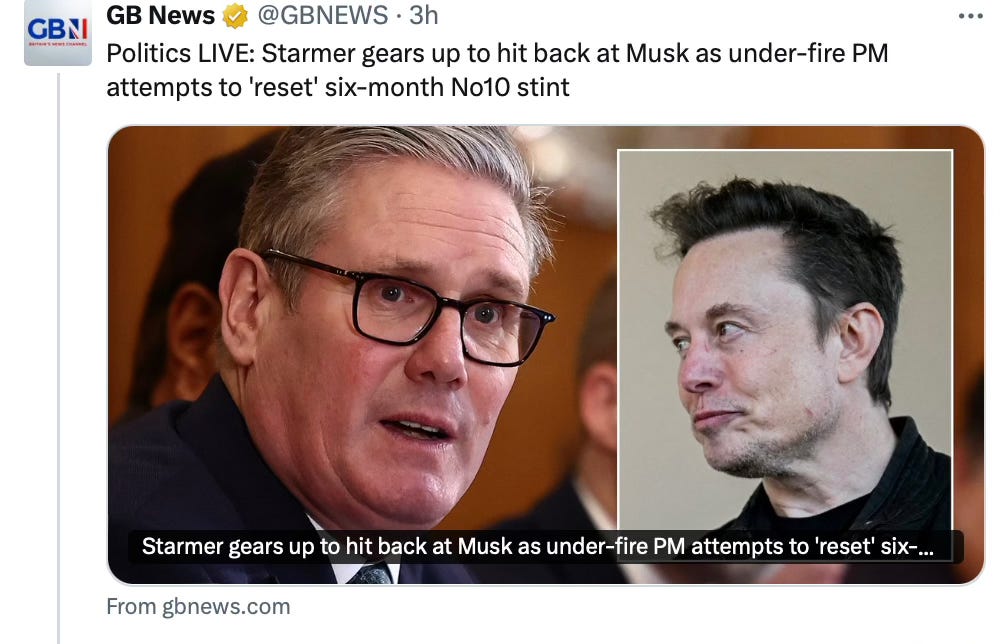
These tweets are just one of many indicators of his contempt for the intelligence of the British public. Above all, they show his own stupidity in underestimating our ability to see through the facile stratagems of the political classes. The tweets are a measure of a man who has still not managed to crack out of his dull, second rate public servant demeanour and blossom into a statesman. He remains wooden and insensitive to the needs of the country. Indeed, there is more than a suggestion that he is following the path set out for him by internationalists within the World Economic Forum and other ‘world government’ institutions. Or he may be following the path laid out by old-school Stalinist Marxism. Or he may be doing both. We do not really know. If there is one thing that Starmer is very good at, it is hiding his intentions and his motivations until he reveals them in yet another destructive diktat.
Even so, given the list above, the question remains: Does Starmer have the qualities necessary to become another Aragorn and be able, singlehandedly, to fight off the gathering armies of the Nazgul (as well as any stray Black Swans) of world and domestic events?
It seems pretty clear to many of us that he does not.